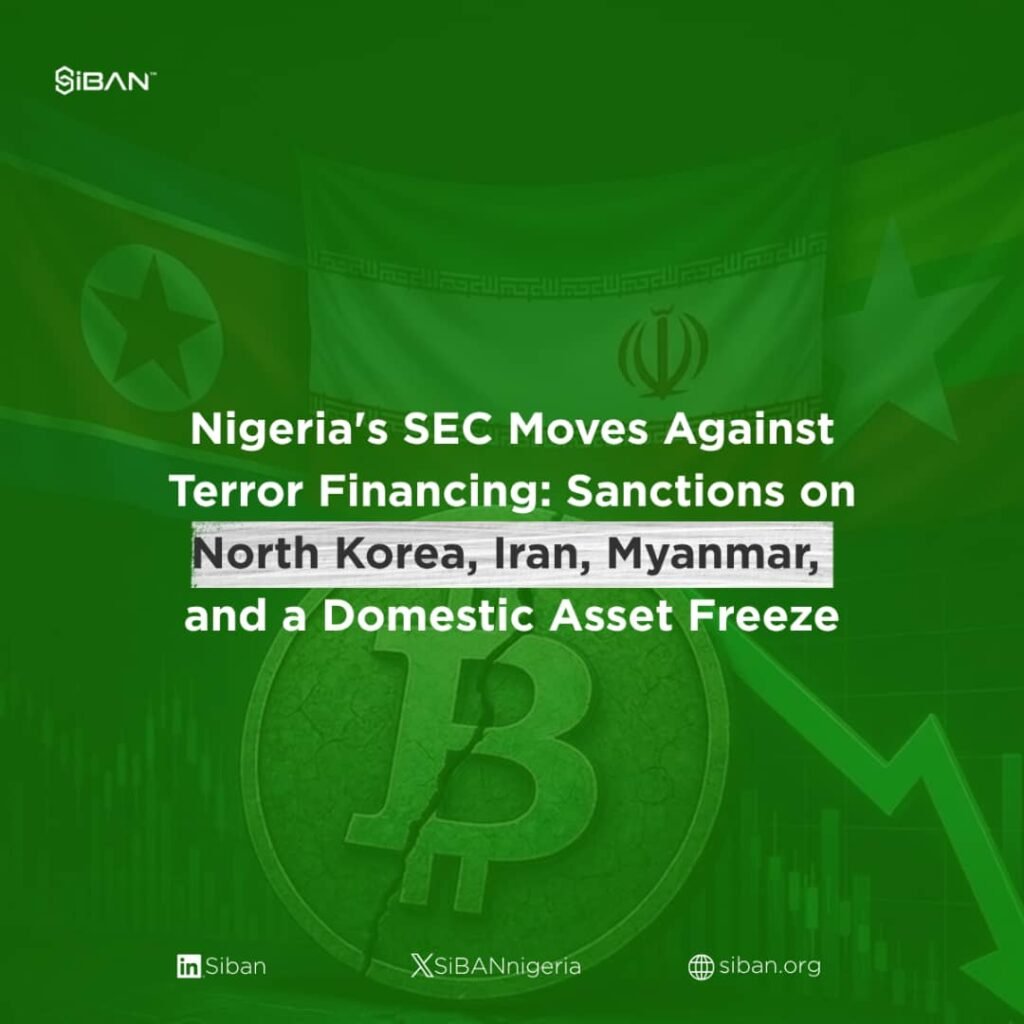
While Nigeria's Securities and Exchange Commission has spent much of this year building out a regulatory on-ramp for crypto firms, it has just as actively been closing off channels it considers dangerous. In a pair of recent directives, the Commission ordered capital market operators to sever ties with financial institutions in North Korea, Iran, and Myanmar, citing Financial Action Task Force guidance, and separately directed the immediate freezing of assets belonging to six individuals and three entities designated as terrorist financiers by Nigeria's Sanctions Committee.
The FATF-Aligned Sanctions Directive
The SEC's circular to listed entities and other Capital Market Regulated Entities laid out specific obligations tied to three jurisdictions FATF has flagged for significant money-laundering, terrorism-financing, or proliferation-financing risk.
For North Korea, operators were directed to terminate correspondent banking relationships with any financial institution incorporated in, owned by, or controlled by North Korean persons or entities, and to ensure no subsidiaries, branches, or representative offices of North Korean financial institutions operate within their structures. For Iran, the Commission instructed operators to refuse to process or facilitate transactions with Iranian financial institutions altogether. For Myanmar, the directive called for enhanced due diligence proportional to risk, rather than an outright prohibition, reflecting the FATF's differentiated treatment of that jurisdiction.
The SEC also flagged a longer list of jurisdictions currently under FATF's increased monitoring, spanning countries across Africa, the Middle East, Asia, and Latin America, and reminded operators of their heightened due-diligence obligations when dealing with counterparties connected to any of them.
The Domestic Asset Freeze
Separately, and arguably more directly tied to Nigeria's own security concerns, the SEC ordered capital market operators to freeze the funds and economic resources of six individuals and three entities designated by the Nigeria Sanctions Committee for financing terrorism. According to the Commission, several of the individuals were listed for direct involvement with or material support to the Islamic State West Africa Province, including financing linked to specific ISWAP cells. Three Bureau de Change operators were named among the designated entities, accused of facilitating the movement of funds connected to the same financing network.
Operators were directed to freeze relevant assets without prior notice, report frozen assets and any attempted transactions to the Sanctions Committee, file suspicious transaction reports with the Nigerian Financial Intelligence Unit, and treat any name match, whether discovered before or after the sanctions list was issued, as suspicious activity requiring escalation.
Can Blockchain Actually Be Used to Curb Terrorism Financing, Not Just Enable It?
The uncomfortable question underlying both directives is whether blockchain-based finance is fundamentally harder to police than the traditional banking rails these sanctions were originally built around, or whether it might, in the right hands, actually be easier. There is a reasonable case for the latter. Public blockchains leave a permanent, traceable record of every transaction, and blockchain analytics firms have become increasingly capable of tracing funds through mixers, cross-chain bridges, and layered wallets to identify patterns consistent with terrorist financing networks. Traditional cash-based or informal transfer systems, by contrast, leave far less of a trail once funds change hands.
The FATF's own recent assessments suggest the real gap isn't the technology, it's implementation. According to the FATF's most recent update on virtual-asset standards, published in July 2026, roughly 83 percent of surveyed jurisdictions have now passed legislation implementing the Travel Rule, which requires virtual-asset providers to share sender and recipient information on transactions, up from about 73 percent the previous year, with several more jurisdictions reporting implementation underway. But passing legislation and enforcing it in practice are different achievements. The FATF has separately warned, in a March 2026 report, that gaps in oversight of offshore virtual-asset service providers are actively being exploited to facilitate large-scale fraud, money laundering, and terrorism financing, precisely the kind of jurisdictional arbitrage that a determined bad actor can exploit even when any single country's rules look reasonably strong on paper.
That points to a few practical levers that we need to lean on. Immediate, no-notice asset freezes prevent designated individuals from moving funds the moment they're identified, rather than after a lengthy administrative process gives them time to relocate assets. Mandatory suspicious transaction reporting, retroactively applied to any historical name match, closes the window that would otherwise let a flagged transaction from months earlier go unexamined. And enhanced due diligence requirements for FATF-monitored jurisdictions push the burden of verification onto the regulated entities processing transactions, rather than relying solely on government agencies to catch illicit flows after the fact.
Cross-border enforcement still depends on cooperation between jurisdictions with wildly different capacity and political will. The open question is whether enforcement capacity, in Nigeria and in the jurisdictions it now requires its regulated entities to treat with caution, can keep pace with how quickly illicit actors adapt.
For players across the industry, the directives are a reminder that these developments are not confined to traditional capital-market operators. As digital-asset and blockchain businesses become increasingly integrated into the regulated financial system, expectations around sanctions screening, transaction monitoring, and due diligence will increasingly shape how they operate.
Keeping up with changes like these matters because the regulatory environment is evolving alongside technology, and understanding where the lines are being drawn is becoming as important as understanding where new opportunities are emerging.