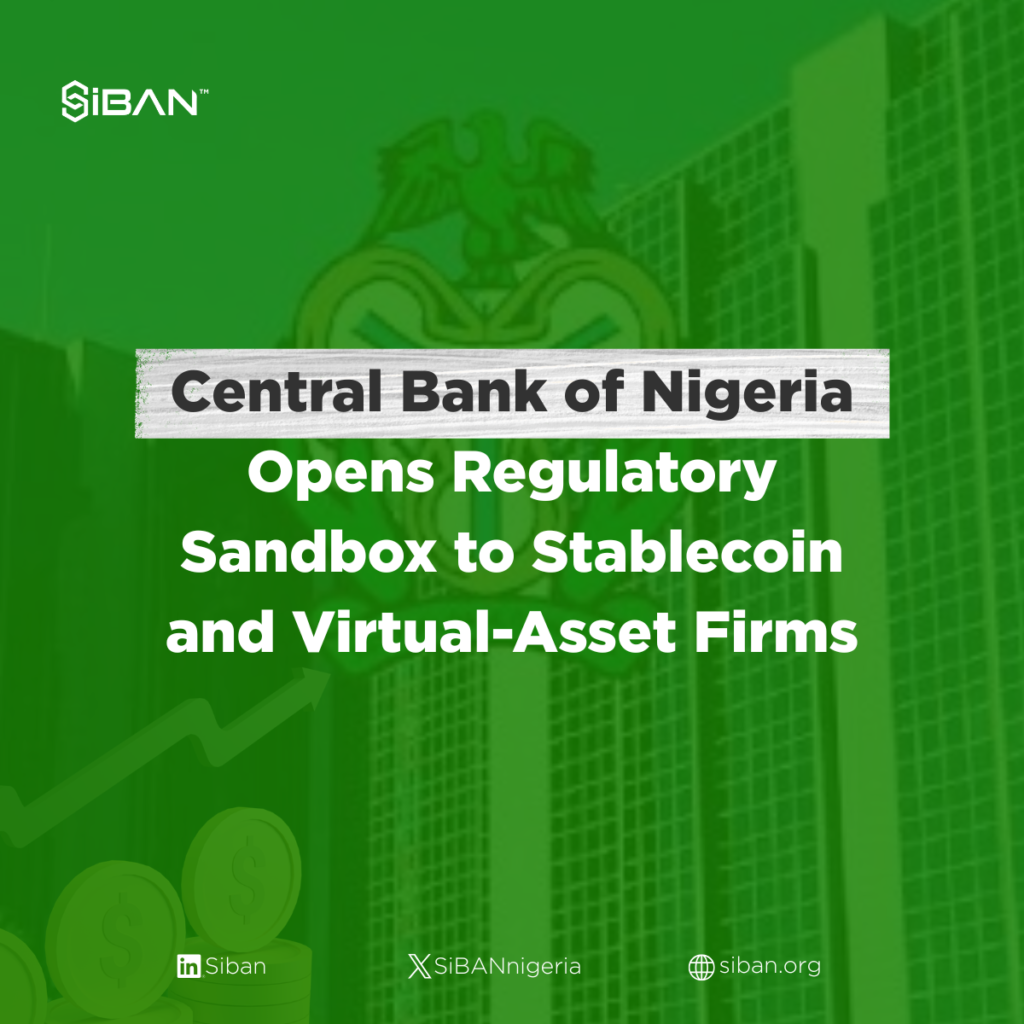
Africa's largest crypto economy just took its clearest step yet toward formal digital-asset supervision. On August 12, the Central Bank of Nigeria (CBN) and for the first time, came with a track built specifically for virtual-asset businesses: stablecoin issuers, wallet providers, custodians, and payment infrastructure firms among them.
It is a striking reversal for a regulator that, five years ago, ordered banks to cut off crypto exchanges entirely. Today, the CBN is inviting the same category of company into a supervised testing environment, a move that says as much about the scale of Nigeria's digital-asset market as it does about how far official thinking has shifted.
Before Cohort 2, the Central Bank of Nigeria's Regulatory Sandbox Programme started with a first cohort that laid the groundwork for how the CBN would supervise fintech innovation going forward.
The purpose was straightforward: to give financial technology companies a controlled, supervised environment in which to test new products, services, and business models before rolling them out commercially. Rather than launching untested innovations directly into the market, participants could trial them under the CBN's direct observation, with the central bank able to study emerging risks and business models firsthand.
Why Now: The Numbers Behind the Pivot
The timing isn't arbitrary. Nigeria pulled in more than $92.1 billion in Sub-Saharan Africa study, roughly three times what South Africa, the region's second-largest market, recorded. Chainalysis also flagged Sub-Saharan Africa as the world's third-fastest-growing crypto region in 2025, with on-chain transaction volume up more than 50 percent year-on-year, and pointed to Nigeria, South Africa, Ethiopia, Kenya, and Ghana as its five biggest markets.
Stablecoins sit at the center of that growth. Chainalysis identified sizable stablecoin flows underpinning trade between Africa, the Middle East, and Asia, functioning as a cheaper, faster alternative to conventional cross-border settlement rails. For a regulator watching that volume move largely outside its supervisory perimeter, a sandbox is a way to get eyes on the technology before writing rules around it.
Inside Cohort 2: Two Tracks, One Coordinated Push
The new cohort splits into two distinct lanes:
- The Virtual Asset Service Provider (VASP) Track, open to companies building products around virtual assets, stablecoins, payments, settlement, custody, and wallet infrastructure. These firms will test live, within parameters agreed directly with the CBN.
- The Data-Enabled Financial Services Track, for non-VASP firms using secure digital infrastructure and permission-based data sharing to improve credit, risk management, payments, and financial inclusion.
Applications opened August 12 and closes August 31, submitted through the CBN's sandbox portal. Musa Jimoh, the CBN's Director of Payments System Policy, framed the dual-track structure as recognition that financial innovation keeps reshaping how people and businesses access financial services, and said the tracks reflect the regulator's intent to keep Nigeria's rules aligned with that shift.
Crucially, admission is not a licence. The CBN has been explicit that sandbox participants may only test within agreed boundaries, covering consumer protection, operational resilience, cybersecurity, and regulatory reporting, and that clearing the sandbox doesn't authorize a company to operate commercially outside it.
Not the CBN's First Move: Building on the AML Pilot
This sandbox doesn't emerge from nothing. Earlier in the year, the CBN ran a pilot with select fintechs, including Flutterwave, Paystack, and Juicyway, to stress-test the stability of payment and cross-border infrastructure tied to stablecoins under closer regulatory watch. That pilot effectively let the central bank observe how stablecoin rails behave inside Nigeria's payment system before deciding how to formalize oversight.
The Cohort 2 sandbox extends that logic into a standing, repeatable programme rather than a one-off exercise, and widens the net well beyond the handful of firms in the earlier pilot.
A Fuller Regulatory Architecture Is Taking Shape
The CBN isn't acting alone, and it isn't acting first. The Securities and Exchange Commission (SEC) has been running its own Accelerated Regulatory Incubation Programme (ARIP) for virtual-asset businesses operating in the capital markets, admitting nine companies through July, including GIGX Technologies and KuCoin Nigeria, both granted Approval-in-Principle status.
What's changed is coordination. President Bola Tinubu's July 18 Executive Order established a harmonised Virtual Asset Council, chaired by the CBN, with the Nigeria Revenue Service and the SEC serving as vice-chairs, and the Nigerian Financial Intelligence Unit and the Office of the National Security Adviser rounding out the membership. The council traces back to a February white paper proposing coordinated oversight across the CBN, SEC, and NRS; the executive order turned that proposal into an operating structure. Its first formal meeting took place at CBN headquarters in Abuja on July 29.
The division of labor is becoming clearer as a result: the CBN oversees virtual assets used in payments, such as stablecoins, settlement, custody, and wallets, while the SEC handles digital assets that function as securities. The Nigeria Revenue Service adds a third layer, having released a tax framework for virtual assets on August 3.
What the Sandbox Track Signals?
Applications will be judged on the level of innovation, readiness for live testing, potential benefit to consumers or the market, governance strength, risk-management capability, and the soundness of the proposed testing plan, the same criteria the CBN has applied since launching the sandbox programme back in 2022, when the first cohort became operational in January 2023.
The Road Ahead
None of this amounts to a finished stablecoin law. Nigeria still doesn't have dedicated legislation that clearly separates a fiat-backed settlement token from either a security or a bank deposit liability. The sandbox and the AML pilot are ways of building institutional knowledge and trust in the absence of that statute, not a substitute for one. But the direction is now unmistakable: a regulator that once told banks to sever ties with crypto exchanges is now building the infrastructure to supervise stablecoin issuers, custodians, and payment processors directly.
For virtual-asset firms operating in or eyeing Nigeria, the message is straightforward. The window to be tested, and eventually recognized, by the CBN is open until August 31. What emerges from Cohort 2 will likely shape how Africa's biggest crypto market writes its rulebook for the years ahead.
Firms navigating this window don't have to do it alone. SiBAN works directly with regulators, connects members to compliance guidance, and gives virtual-asset businesses a seat at the table as these frameworks are being written. If you're serious about being recognized in Nigeria's regulated crypto space, this is the community to be part of.
To become a member of SiBAN, send an email to membership@siban.org to begin the membership process. You can also connect with the community by joining the SiBAN Telegram group,
One Response