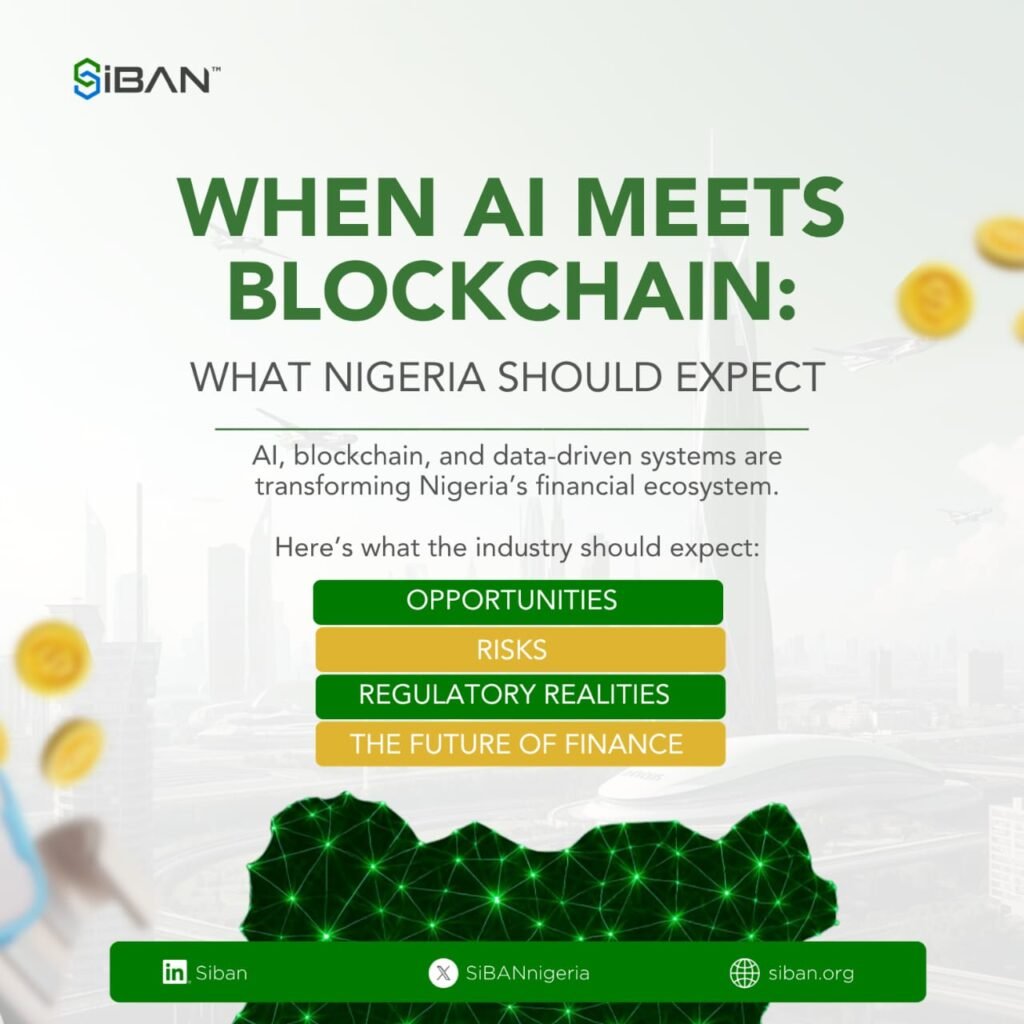
How can AI and blockchain improve financial services and the broader economy? What risks do these technologies pose? What regulatory frameworks currently exist for AI? Can artificial intelligence make blockchain systems more efficient, secure, and scalable?
These are some of the major questions increasingly being asked by financial institutions, technology providers, and policymakers across Nigeria’s evolving digital economy.Artificial intelligence (AI), blockchain technology, and data-driven systems are rapidly transforming Nigeria’s financial services landscape.
From smarter compliance systems and fraud detection to digital payments, tokenization, and automated financial processes, both technologies are beginning to reshape how financial systems operate. However, industry stakeholders continue to warn that governance structures, regulatory frameworks, and institutional readiness are struggling to keep pace with the speed of innovation.
AI, Blockchain and the Financial Ecosystem
Across global markets, AI and blockchain are already influencing payments, digital identity, compliance, capital markets, and financial services. However, while innovation is moving rapidly, governance and regulation are still evolving to match the speed and complexity of these technologies. AI also introduces new risks to financial systems, including algorithmic bias, data privacy concerns, cybersecurity vulnerabilities, automated fraud, and the possibility of inaccurate decision-making at scale if systems are not properly monitored.
At Stakeholders in Blockchain Technology Association of Nigeria, discussions across the industry continue to focus on how regulators, financial institutions, and technology providers can balance innovation with accountability, consumer protection, operational transparency, and long-term market stability.
What to Expect in the Near Term
The convergence of AI and blockchain will show up in Nigeria in practical ways before it shows up in policy. Here is what the industry should be watching for:
- Faster, cheaper compliance. AI systems embedded in blockchain platforms will begin automating KYC and AML processes that currently require significant manual effort and cost. For smaller fintechs and VASPs, this will reduce the barrier to operating compliantly. For regulators, it will mean more consistent and auditable compliance records.
For example, a Nigerian crypto exchange using AI-powered identity verification could automatically flag suspicious wallet activity, verify customer identities using BVN-linked data, and generate compliance reports in real time instead of relying on lengthy manual reviews.
- Credit access for the unbanked. AI can assess creditworthiness from alternative data mobile transactions, airtime usage, trading patterns. Blockchain can store and verify those assessments in a form that lenders trust. Together, they open a pathway to credit for millions of Nigerians who currently have none.
- Smarter tokenized markets. As tokenized assets grow in Nigeria, AI will increasingly be used to price, trade, and manage risk on those assets at speeds and price points that bring institutional-grade tools to retail investors for the first time.
- New fraud detection capabilities. AI trained on on-chain transaction data can identify suspicious patterns far more quickly and accurately than traditional monitoring systems. This matters enormously in a market where financial fraud costs the economy hundreds of billions of naira annually.
What the Regulatory Environment Should Be Prepared For
As the representative body of Nigeria's blockchain industry, SiBAN can share what her members are already encountering and what the regulatory environment will need to be ready to address.
AI-driven financial products are already operating in Nigeria. Some of them sit clearly within existing frameworks. Many of them do not. As AI becomes more deeply embedded in blockchain platforms making investment decisions, assessing credit, executing trades the question of accountability becomes unavoidable. When an algorithm makes a decision that harms a retail investor, who is responsible? That question deserves a clear answer before the products become widespread, not after.
SiBAN's Role in This Conversation
SiBAN exists to ensure that new technology serves Nigeria's people, not just its early adopters. As AI and blockchain converge, SiBAN will be the space where founders, investors, regulators, and civil society can work through the implications together, before they become problems.
We are positioning ourselves as the convening space for an honest conversation about what this convergence means for Nigeria, its markets, its regulators, its entrepreneurs, and the millions of Nigerians who stand to benefit most from getting it right.
If you are building at this intersection, or thinking about what it means for your institution, SiBAN is the right room to be in. To become a member of SiBAN, send us an email membership@siban.org, or you can also join our SiBAN Telegram community!