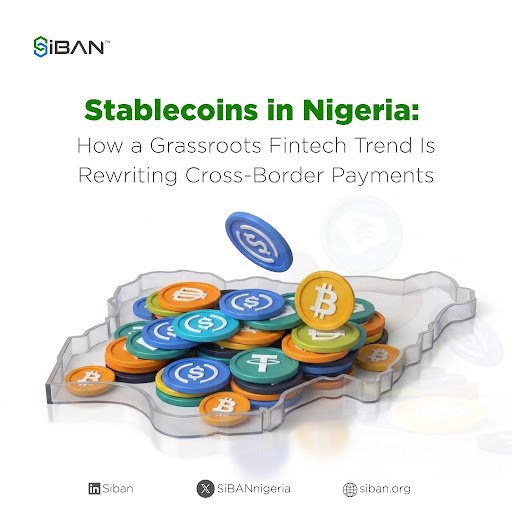
If you want to see the future of cross-border payments, don't look at a bank boardroom, look at a Nigerian small business owner paying an overseas supplier from their phone in minutes, using a dollar-pegged digital token most Western regulators are still trying to define.
That's the story emerging from Nigeria, where stablecoins have moved from a niche crypto curiosity to a genuine cross-border payments channel, according to recent IMF analysis. And the scale is hard to ignore.
The numbers behind the trend
Nigeria pulled in an estimated $59 billion in crypto-asset inflows between July 2023 and June 2024. That volume put the country second in the world on Chainalysis's 2024 Global Crypto Adoption Index (sixth in 2025), and it now accounts for roughly 60% of all stablecoin inflows across sub-Saharan Africa since 2019.
This isn't speculative trading. It's households sending remittances, and small firms settling invoices with partners abroad, real economic activity flowing through a channel that barely existed a decade ago.
Why stablecoins are winning
The pitch is simple: anyone with a smartphone and an internet connection can send or receive dollar-denominated value in minutes, often far more cheaply than the alternative. That matters in a region where the World Bank pegs the average cost of sending $200 at around 9% of the transfer's value, well above the 6% global average.
Local conditions poured fuel on the fire. The naira's sharp depreciation in 2023–2024, elevated inflation, and tight limits on foreign exchange access all pushed households and businesses toward dollar-linked assets as both a hedge and a practical payment tool. When Nigeria's central bank restricted banks from servicing crypto exchanges back in 2021, activity didn't disappear, it simply moved to peer-to-peer platforms with less regulatory visibility.
The trade-offs regulators can't ignore
Faster, cheaper payments are an unambiguous win for financial inclusion and trade. But the same features create two real headaches for policymakers:
- Monetary sovereignty: Most stablecoins are dollar-denominated, widespread adoption starts to look like informal dollarization, a slow erosion of demand for the naira that can dull the effectiveness of domestic monetary policy.
- Financial integrity: Money that once moved through banks, where it could be monitored, is increasingly moving through wallets and exchanges that traditional oversight systems weren't built to see. That opacity raises the risk of illicit finance.
Nigeria isn't unique in facing these tensions, but its scale of adoption makes them impossible to ignore.
A more realistic path forward
Trying to simply ban stablecoin use tends not to work, it just pushes activity further underground. IMF analysis points to a more pragmatic four-part approach:
1. Keep the naira credible: The best defense against digital dollarization is a stable domestic currency. Nigeria's recent macro reforms and tighter monetary policy have already helped rebuild confidence.
2. Sharpen regulatory oversight: Nigeria has started this work through SEC rules for virtual asset providers and CBN guidance on bank-exchange relationships. The next step is clarifying rules for stablecoin issuers themselves, in line with frameworks emerging in the EU, Singapore, Hong Kong, Japan, and the US.
3. Get better data: Regulators need real visibility into how stablecoins move through the economy, particularly where they convert back into naira. Blockchain analytics paired with conversion reporting could help catch risks early.
4. Fix the infrastructure gap: A lot of stablecoin demand exists simply because faster, cheaper official alternatives don't. Continued investment in instant domestic payments and regional systems like the Pan-African Payment and Settlement System could pull activity back into regulated channels.
The Bigger Picture
Nigeria's experience shows what every emerging market will eventually face: how to embrace digital money without losing control of local currency and financial systems.
The answer isn't restriction, it's building trusted, official systems people actually want to use.
Join SiBAN as we help shape that future. Email membership@siban.org or join our Telegram community to be part of the discussion.