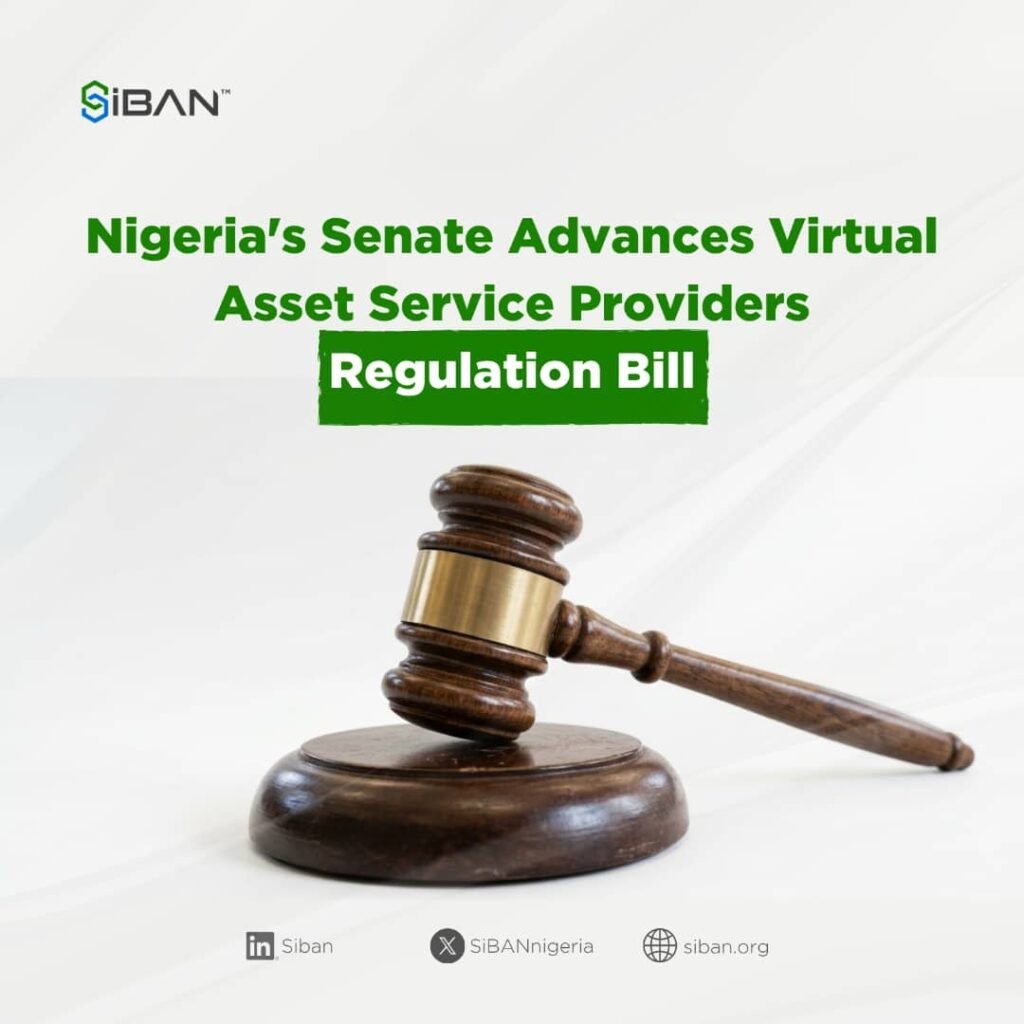
The Nigerian Senate recently passed the Virtual Asset Service Providers Regulation Bill, 2026 (SB 956) for second reading, moving the proposed legislation one step closer to becoming law. The development, which took place on June 9, 2026, marks one of the most significant legislative moves yet toward establishing a formal legal framework for cryptocurrency and digital asset operations in Nigeria.The bill was sponsored by Deputy Senate President Senator Jibrin Barau and presented on the Senate floor by Chief Whip Senator Tahir Monguno.
It is important to note that a second reading does not mean the bill has been passed into law. It signals that the Senate has approved the bill in principle for further debate and review. The bill has since been referred to the Senate Committee on Capital Market, with a four-week window set for committee review, public hearings, and stakeholder consultation.Nothing has been signed. Nothing is yet law. But the process is now firmly in motion, and our members need to be paying attention.
Why This Bill Is Coming Now
Nigeria is one of the world's largest adopters of cryptocurrency. That is not a new fact. It has been true for several years, driven by a young, digitally active population, currency pressures, a thriving fintech culture, and the practical need for efficient cross-border transactions. What has been conspicuously absent, however, is a clear legal framework to govern the space.That gap has had real consequences. Investors have been exposed to fraud with little legal recourse. Illicit activity has found room to operate without oversight.
International companies and institutional investors have repeatedly cited regulatory uncertainty as a reason to look elsewhere. Several African countries have already moved ahead in regulating the digital asset space, and lawmakers cited this during the Senate debate as part of the motivation for advancing the legislation now.
South Africa declared crypto assets as financial products under the FSCA, Kenya also qqenacted the Virtual Asset Service Providers Act covering exchanges and stablecoins; Mauritius has been regulating digital assets since 2021 via the VAITOS Act; Ghana mandated registration for all VASPs as it works toward a full licensing framework.
What the Bill Proposes?
In its current form, the Virtual Asset Service Providers Regulation Bill seeks to introduce a comprehensive legal and supervisory framework covering:-
- Cryptocurrency exchanges
- Digital asset custodian
- Blockchain service providers
- Other platforms classified as Virtual Asset Service Providers (VASPs).
Key proposals within the bill include mandatory licensing for all VASPs operating in Nigeria, compliance and transparency requirements, and investor protection provisions. The bill also signals Nigeria's intent to align with international regulatory standards set by the Financial Action Task Force (FATF) and the International Monetary Fund (IMF).
During the Senate debate, lawmakers across party lines expressed broad support for the principle of regulation, while some notably Senator Adetokunbo Abiru raised the important point that the bill must be carefully harmonized with existing financial legislation, including the Investments and Securities Act and the Banks and Other Financial Institutions Act (BOFIA).
Where Things Stand Right Now?
To be clear about the current state of play:
The bill has passed its second reading in the Senate. It has been referred to the Senate Committee on Capital Market for a period of review lasting approximately four weeks. During this time, public hearings will be held and stakeholders will have the opportunity to make submissions and give input.
The full text of SB 956 has not yet been widely published or made publicly available, something that will need to be addressed as the process moves forward.After the committee stage, the bill will return to the Senate for further readings before any question of assent arises. There is still a considerable distance between where this bill is today and it becoming enforceable law.
Impact of the VASP bill
Whether this bill ultimately proves beneficial or burdensome to Nigeria's blockchain ecosystem will depend heavily on what happens in the next few weeks specifically, during the committee review and public hearing stage.
This is the window during which the details of the framework will be shaped, and details matter enormously in legislation of this kind.How licensing requirements are structured, how compliance costs are calibrated, how the law interacts with existing financial regulation, and what philosophy ultimately guides enforcement, these are the questions that will determine whether this legislation creates enabling conditions for the industry or adds layers of complexity that slow it down.
Members should be aware that this process is happening, that there will be opportunities for industry input, and that engaging now is far more effective than reacting after the fact.SiBAN will continue to monitor developments closely and will keep members updated as the bill progresses through the committee stage and beyond. But beyond updates, this is a moment that calls for unity. Founders and operators cannot afford to work in silos while policies that will define this industry are being written in boardrooms and legislative chambers.
The only way to have a seat at the table is to speak with one voice and that voice gets louder with every member that joins. If you are serious about the future of blockchain and digital assets in Nigeria, the best decision you can make right now is to align with the strongest industry association in the country.