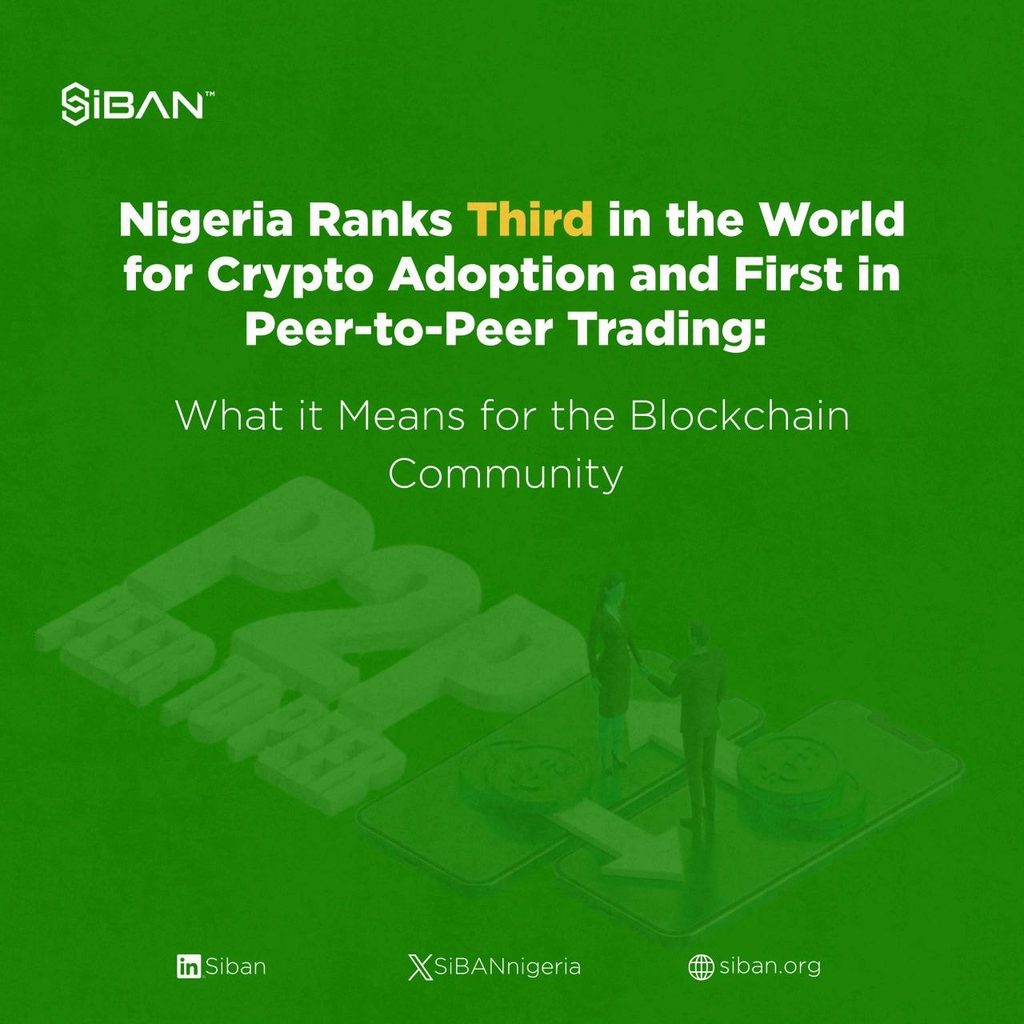
Nigeria has been ranked third in the world for grassroots crypto adoption, and first in the world for peer-to-peer crypto activity and cross-border crypto flows, according to the Chainalysis 2026 Global Crypto Adoption Index. The index covers 117 countries. Only Brazil and the United States ranked ahead of Nigeria.
For Nigerians, this is more than a ranking. It describes how traders, freelancers, importers, families and businesses are using digital assets in daily life, and it raises questions about what the country should do next. SiBAN, the association of stakeholders in Nigeria's blockchain industry, has prepared this article to explain what happened, what it means for us, why government attention on the crypto economy has grown, and which areas we should be looking into.
What Happened?
The index ranks countries on four measures: service flows (money going into exchanges and other crypto platforms), peer-to-peer activity (value moving directly between personal wallets inside a country), cross-border flows (value moving between countries) and on-chain balances (the value people and platforms hold). Nigeria's results were:
Overall adoption: 3rd in the world.
Peer-to-peer activity: 1st in the world.
Cross-border flows: 1st in the world.
Total service flows: 18th.
On-chain balances: 18th.
Nigeria placed ahead of Japan (4th), the Republic of Korea (5th) and India (6th). Brazil ranked first overall without topping any single measure, because the overall score rewards consistency across all four. Nigeria did the opposite. It led two measures outright, and those results were strong enough to lift it to third place despite mid-table results on the other two.
The ranking covers the 12 months to June 2026, one of the hardest periods the crypto market has faced. The total value of all cryptocurrencies fell by about 50%, a loss of $2.1 trillion, and Bitcoin lost $67,000 from its peak to its lowest point. Even so, worldwide on-chain economic activity slipped by only 1.6%, from $9.5 trillion to $9.4 trillion. People kept using crypto because they use it for more than investment.
The Numbers Behind the Ranking
Three findings from the report explain why Nigeria's results matter.
- Stablecoins carry everyday payments: Stablecoins are digital tokens pegged to a currency such as the dollar. Cross-border stablecoin transfers grew 77.5% over the period, from $124.2 billion to $220.3 billion. The average payment was about $3,000, which the report describes as too small to be institutional and consistent with people paying suppliers, sending money home or moving savings out of a currency they no longer trust.
- Peer-to-peer activity exploded: Value moving directly between personal wallets inside countries rose 302.9%, from $56.8 billion to $228.7 billion, and 96% of it is now in stablecoins. Trading on exchanges follows prices, so it shrinks when the market falls. A stablecoin payment is set by what the sender needs to move, so it continues in good times and bad.
- Small users stayed active: Transfers under $100 into crypto platforms rose 78.4%, and transfers of $100 to $1,000 rose 58.6%. Ordinary users, not just large investors, kept using crypto through the downturn.
Analysis: because peer-to-peer activity worldwide is almost entirely stablecoins, Nigeria's first place most likely reflects Nigerians paying and receiving dollar-denominated value directly, wallet to wallet. The first place in cross-border flows points the same way, to strong use of crypto for sending and receiving money across borders.
Nigeria's 18th place in balances and service flows is the other side of the picture. It suggests that value moves through Nigeria quickly but that less of it stays on-chain as savings or as funds held with regulated platforms. The report also adjusts service activity for income levels, which works against lower-income countries in those two rankings. Nigeria's strength is in use, and depth is still to be built.
What This Means for the Nigerian Economy?
Analysis: the ranking has different consequences for different groups.
- Households and individuals: Many Nigerians already use stablecoins to protect value and send money. That brings benefits such as speed and lower cost, but also risks: scams, wrongly sent transfers that cannot be reversed, and losses if a stablecoin fails to hold its value.
- Traders, freelancers and small businesses: Getting paid from abroad, paying overseas suppliers and settling
trade are areas where crypto is filling a gap. Businesses that understand this can cut costs. Those that ignore it may lose customers and talent to those who do not.
- Banks, fintechs and payment providers: Nigeria's first place in peer-to-peer and cross-border activity shows demand for fast, cheap transfers. Providers that build safe, compliant ways to move between naira and digital assets stand to gain.
- Regulators and government: Large flows that move directly between people, often in dollar-linked assets, are harder to see and harder to tax or supervise. This raises questions about oversight, foreign exchange, tax collection and consumer protection.
- Builders and investors: Strong everyday demand, combined with low balances and service use, marks a clear gap. Products for saving, payments and trusted custody can serve people who are already active.
These numbers help explain why the Nigerian government and its agencies have turned more attention to crypto this year. Nigerian regulators, including the Securities and Exchange Commission, the Central Bank of Nigeria and the tax authority, have all engaged with digital assets. The data shows why this attention makes sense.
As the association that brings industry stakeholders together, SiBAN sits at the point where builders, businesses, investors and policymakers meet. Ongoing dialogue between industry and government is the best way to make sure rules reflect how Nigerians actually use digital assets.
What this means for policy and the ecosystem
A first-place ranking in peer-to-peer and cross-border activity carries responsibility. Nigeria's users, builders and regulators are all being watched. SiBAN believes the following should guide the next phase:
- Regulation should follow usage: Rules work best when they reflect how Nigerians actually use digital assets, including stablecoins and peer-to-peer channels.
- Consumer protection must keep pace: Chainalysis warns about scammers, including fake recovery services. As adoption grows, so do fraud risks, and investor education is essential.
- Local infrastructure should be built for payments: The evidence points to stablecoin payments as the main driver of growth, and that is where Nigerian builders have room to lead.
- Data and reporting matter: Nigeria's story should be told with credible data. SiBAN will keep working with regulators, industry and researchers on this.
Keep the Limits in Mind
The figures are estimates. Service activity is assigned to countries using website traffic, which is imperfect, and the report says its totals are very likely an underestimate. Rankings show relative strength, not absolute size, and transfers that cannot be attributed to a country are left out. The findings are strong evidence of direction, but they should be read alongside local data.
Conclusion
Nigeria's ranking as third in the world for crypto adoption, first in peer-to-peer activity and first in cross-border flows shows how widely digital assets are used in daily life, even when markets fall sharply. That is an opportunity, and it comes with responsibility. It explains why government attention has grown, and it shows what needs to be done: protect users, keep rules clear, improve payment tools, and turn strong activity into lasting value for Nigerians.SiBAN invites builders, businesses, professionals and everyone with an interest in Nigeria's blockchain future to follow SiBAN's updates, join the conversation and become part of the association.