
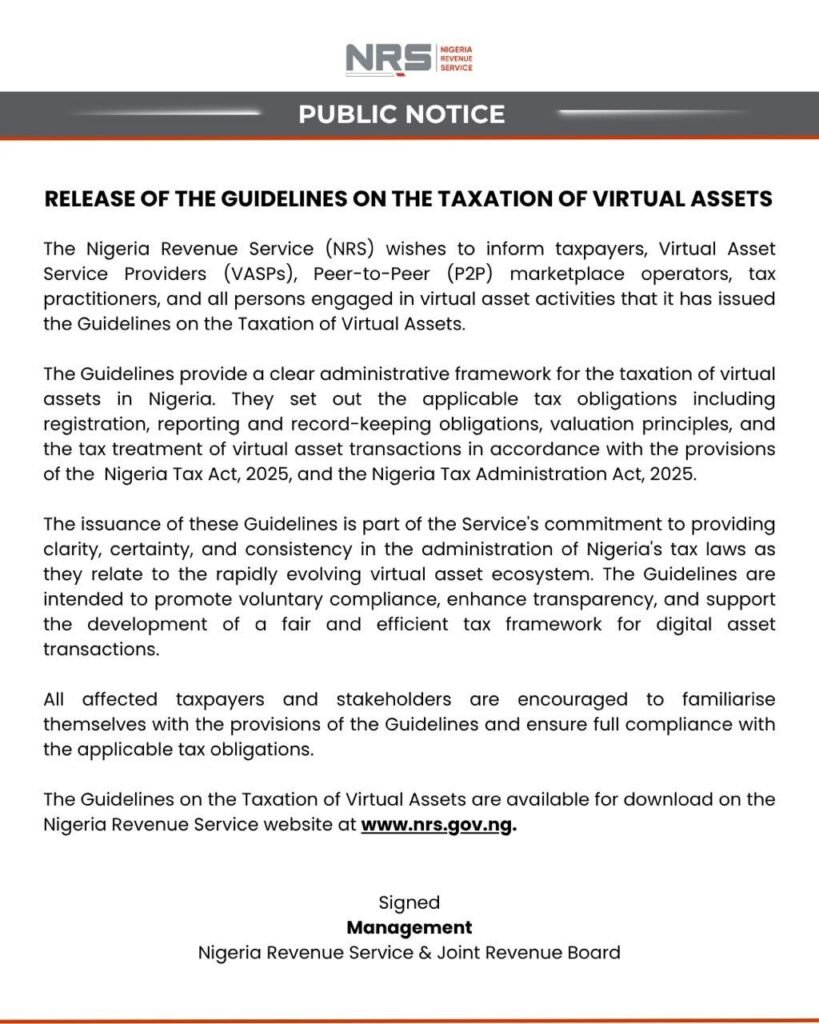
Recently, the NRS released its guidelines on the taxation of virtual assets, giving Nigeria's digital asset holders long-awaited clarity on where they stand. SiBAN has put out its own response to the framework shortly after, and it is worth engaging with in full. The clarity itself is genuinely welcome. But clarity on whether virtual assets will be taxed is not the same as clarity on how they should be taxed, and that distinction is the substance of SiBAN's response below.
SiBAN Weighs In on Nigeria's New Virtual Asset Tax Guidelines
The issue with the current guidelines is that the NRS taxes movement, not gain. Stamp duty on the way in, stamp duty on the way out, withholding on top of that, VAT layered on the fees, all of it stacked upon a single transaction whether the trader made money or lost his shirt entirely.
Kenya attempted precisely this in 2023 with its 3% Digital Asset Tax on gross transfer value, and by 2025 had scrapped it, because taxing turnover rather than profit simply pushes activity into unregistered peer-to-peer channels where the NRS cannot see it at all. That is the risk here with the NRS's approach.
Speaking on the new Tax guidelines, President, Barr. Mela Claude Ake said

“A sounder basis is realised gain, not transaction value. Nigeria already taxes securities and property on a gains basis with cost recovery; there is no principled reason virtual assets ought to be treated differently.”
A person who sells at a loss ought not to owe stamp duty on the way out the door; someone who moves crypto between two wallets of his own certainly ought not to either. Taxing capital before any profit exists is not merely unfair, it is self-defeating. It teaches people to avoid the very regulated exchanges the guidelines are meant to formalise.
Should there remain an appetite for a transaction-based levy purely for data-collection purposes (and one can appreciate the administrative logic of it, given how little Nigerians are inclined to self-report), then it ought to apply once, on a single leg of the trade, at something nearer 0.1–0.5%, rather than 1.5% stacked with a separate 1–10% withholding charge on the very same event. It is precisely this combination that produces a ₦64,250 levy on a ₦1 million trade, a rate exceeding the full capital gains bill in most comparable jurisdictions before profit has even entered the picture.
The 10% rate on staking, mining, and airdrops is better left as it stands, these are harder to trace, closer in character to passive or unearned income, and a firmer hand there is defensible. But charging active traders a 1% withholding levy plus stamp duty on ordinary disposals, while passive holders escape the double imposition, gets the incentives quite the wrong way round for a regulator wishing to see people trade through licensed exchanges rather than around them.
Loss relief, too, must be built in explicitly. India's flat 30% with no offset whatsoever against losses is widely regarded, even by its own commentators, as the single worst design flaw in that framework. It is the principal factor driving liquidity off domestic platforms. Nigeria ought not inherit that error when it is so readily avoided.
Given also that the NRS is pursuing a ₦40.7 trillion revenue target for 2026, there is an evident institutional pull towards taxing harder rather than more sensibly. A mandatory review clause (some twelve to eighteen months post-implementation, tied to actual VASP registration figures and exchange volume rather than revenue collected) would allow the framework to correct itself, as Kenya's eventually did, rather than waiting for traders to vote with their feet.
Fixing the system: What should be done next?
Nigeria has, at present, constructed one of the most tax-dense crypto lifecycles anywhere, at the very moment its closest African peer demonstrated that the opposite approach serves state visibility rather better. The point is not to tax virtual assets lightly as a matter of principle; it is to tax the right event, once, at a rate capable of withstanding competition from the informal market.
The window to fix this is now, before habits and tax software and enforcement precedent all calcify around the current design. The NRS, the National Assembly, and the industry it is meant to regulate have a narrow opportunity to get this right before the informal market makes the decision for them. Nigeria should take it.
These tax guidelines need more work, and SiBAN is ready to do its part, be a part of that voice. Join SiBAN today: email membership@siban.org, or also join our Telegram community for updates regarding the blockchain ecosystem