For Nigeria, this is a defining moment on its path toward building a thriving digital economy. The country has emerged as one of Africa’s most dynamic blockchain ecosystems, powered by a rapidly expanding community of developers, startups, and digital entrepreneurs. Yet alongside this growth lies a critical question: can regulation keep pace with innovation without slowing it down?
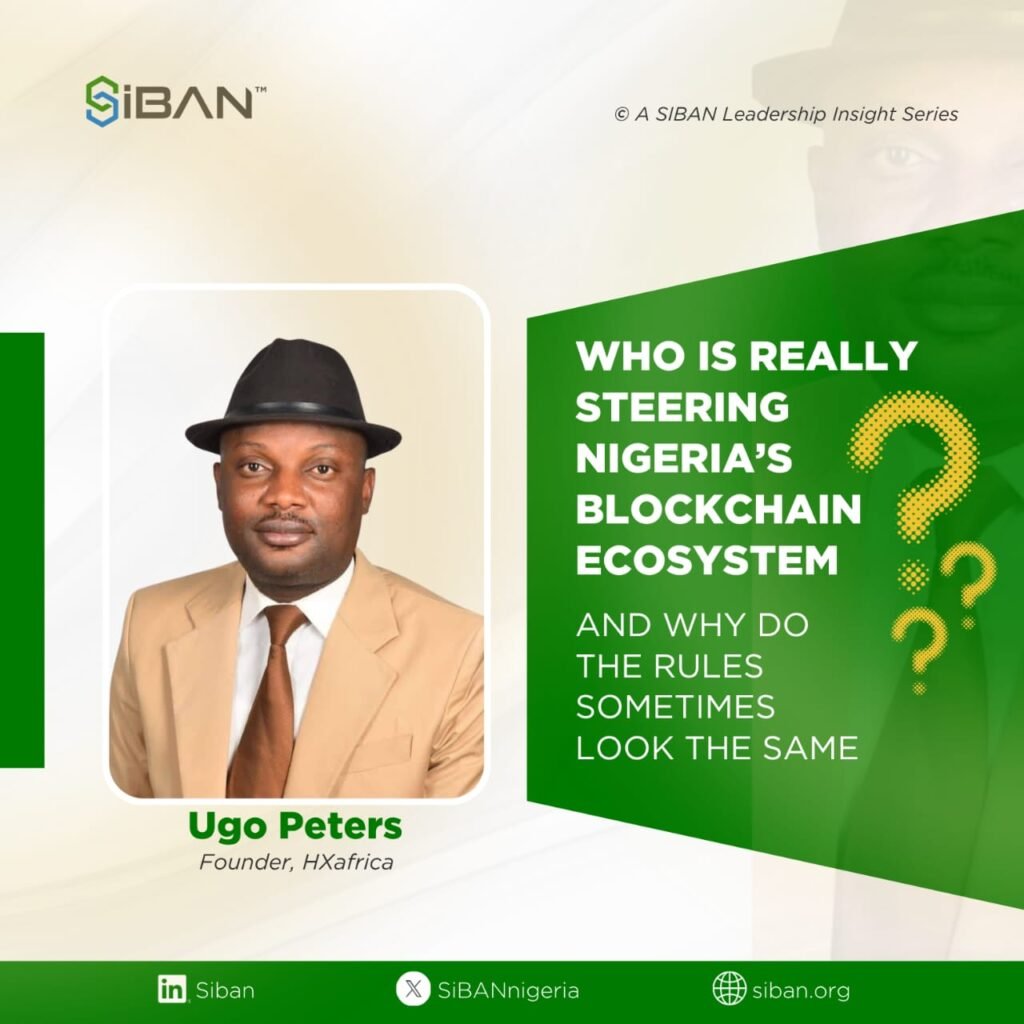
To address this issue, we spoke with a senior leader at the Stakeholders in Blockchain Association of Nigeria (SIBAN) Mr Ugo Peters, who serves as the Vice President,Capital Market Relations and Digital Assets Operations. He is also the founder of HxAfrica, a platform that tokenizes real estate assets and has received approval in principle from the Securities and Exchange Commission Nigeria to operate as a digital asset exchange.
Who Governs Nigeria’s Blockchain Ecosystem?
The question of who truly regulates Nigeria’s blockchain sector is more complex than it appears. Legally, the Investment and Securities Act (ISA) 2025 places the Securities and Exchange Commission (SEC) at the center of digital asset oversight, providing a structured licensing pathway for most blockchain-related operations.
“As far as ISA 2025 subsists, the defined regulator is the SEC, as it has a clear path to licensing with rules that cover most parts of operations in the blockchain industry.”
“So, as it is today, SEC takes leadership in steering Nigeria’s blockchain ecosystem; however, CBN has some overlapping oversight.”
This overlap is not unusual for a rapidly evolving sector, but it highlights the need for clearer coordination among regulators.
The Real Cost of Regulatory Fragmentation
For startups, regulatory overlap is not merely a governance issue, it is a business risk. Multiple compliance pathways complicate planning, delay market entry, and increase operational costs, particularly for companies offering services that span both financial markets and payment systems.
“The emergence of several paths to regulation is a core issue to startups setting out plans and expenditure schedules to close out on registration.”
“For those who have overlapping services, the cost implication becomes a burden.”
“Most start-ups operate within the agile work environment; this is a big contrast to the bureaucratic approach of the regulators.”
Without clearer alignment, this friction could discourage compliance and slow the pace of innovation.
Why a Unified Framework Matters
Nigeria’s recent removal from the grey list of the Financial Action Task Force marked a major step forward in strengthening financial credibility and attracting international investment. But maintaining that progress will require consistent regulatory coordination.
“The consequence of having multiple regulatory frameworks is that it will discourage compliance and expose Nigeria to possibilities of being returned into the grey list; this is a guaranteed ripple effect.”
Industry leaders increasingly believe the long-term solution is a single, harmonized regulatory structure.
“We expect that we need one harmonized regulation, with an independent commission that captures the various interests set up by an act of parliament.”
Such a framework would improve efficiency, strengthen oversight, and enhance investor confidence in Nigeria’s digital assets sector.
Looking Ahead: Regulation as an Economic Strategy
The future of Nigeria’s blockchain industry will depend not only on innovation but on institutional strength. Effective regulation must move beyond enforcement to become a driver of economic growth encouraging consolidation, strengthening capital reserves, and integrating digital assets into the broader financial system.
“Stronger regulations is only a means to an end. In five years, we expect to see at a minimum of five unicorns emerging from the industry through consolidations.The sector should be leading in contributions to GDP and earning USD sufficiently to stabilize and strengthen the naira.”
This vision positions blockchain not as a niche technology, but as a strategic pillar of Nigeria’s digital economy.
Building Nigeria’s Blockchain Future Together
As Nigeria’s digital assets ecosystem continues to evolve, collaboration between industry, regulators, and policymakers will be essential. Being part of Stakeholders in the Blockchain Association of Nigeria is more than membership, it is a signal of credibility, access, and influence within one of Africa’s fastest-growing technology sectors.
It places organizations and professionals in the company of industry leaders, regulators, and innovators who are defining the future of digital assets in Nigeria.For those building, investing, or regulating in the blockchain space, membership is not just participation, it is positioning.
To become a member of SiBAN, send us an email membership@siban.org, or you can also join our SiBAN Telegram community!