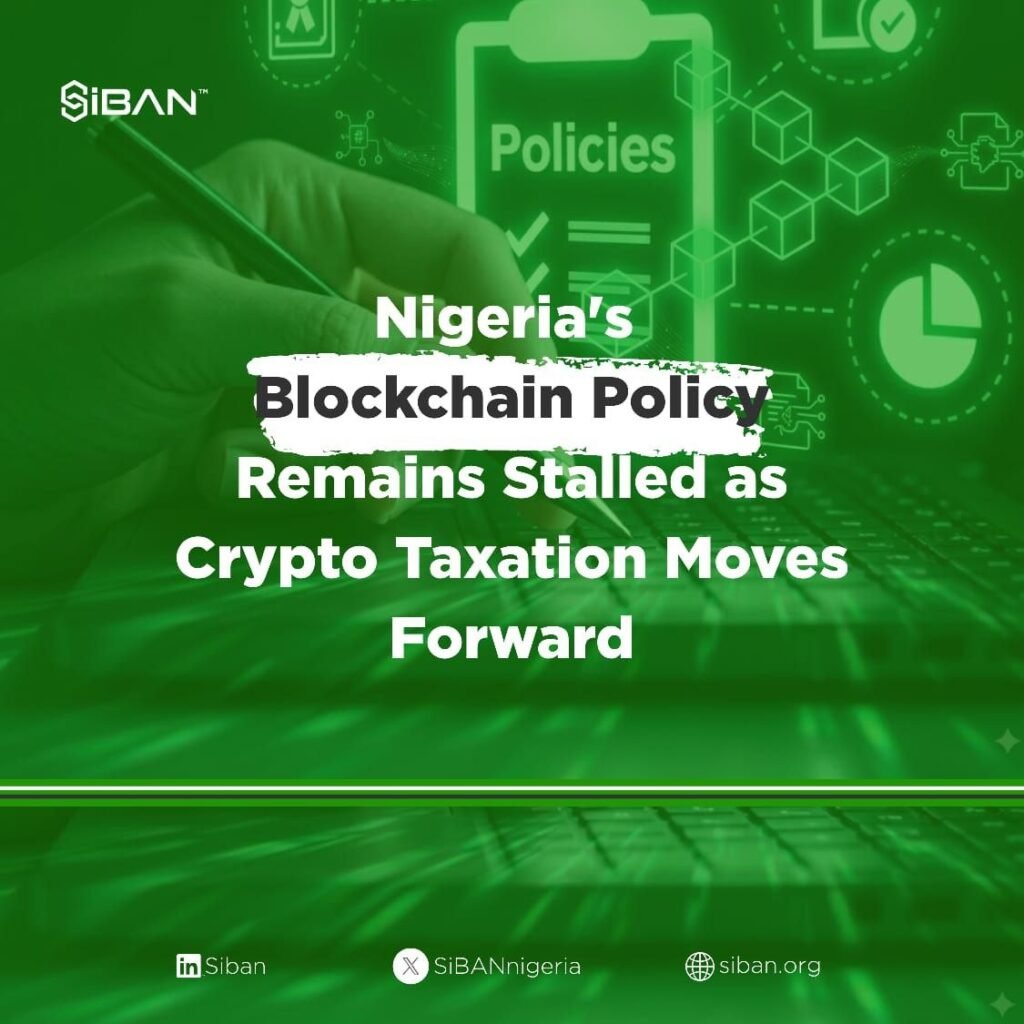
Nigeria may be leaving significant long-term economic gains on the table as government attention increasingly centres on regulating the digital-asset sector, while a broader national blockchain strategy remains largely unimplemented. This is worth bringing to public attention, given how much is riding on the outcome.
A Policy Launched, Then Left Idle
The National Blockchain Policy was launched in 2023 under former President Muhammadu Buhari, making Nigeria the only country in Africa to have adopted a formal national blockchain policy. More than two years on, its execution has stalled, as policymakers have instead concentrated on giving investors a clearer regulatory framework for digital assets and cryptocurrencies.
Progress has been visible on the crypto side of that equation: the current administration has signed the Virtual Assets Executive Order and moved to implement the Investments and Securities Act (ISA) 2025, steps aimed at reducing institutional silos and strengthening consumer protection. The National Blockchain Policy has not seen comparable movement, even as blockchain technology is increasingly viewed worldwide as critical infrastructure for digital transformation.
There has been no meaningful implementation of the policy since the current administration took office, despite expectations that progress would accelerate rather than stall. Pushing the blockchain policy to the background carries real costs: Nigeria's early move to adopt a national blockchain policy gave it a potential leadership role in blockchain innovation across Africa, and failing to build on that head start weakens the country's position as a possible blockchain hub. The slow pace also raises a fair question worth putting to policymakers directly: whether the rollout is being deliberately paced, or whether the policy has effectively been shelved.
It is also worth noting that blockchain's relevance extends far beyond digital assets. The technology is capable of touching nearly every part of the economy and society, from oil and gas and mining to governance, healthcare, education, public service, infrastructure, supply chains, and agriculture, with most of these sectors standing to benefit if the policy were fully implemented.
Why the National Blockchain Policy Remained Dormant?
SiBAN has, for years, set the pace on issues most were still catching up to. Long before government attention turned meaningfully toward digital assets.
SiBAN was already in the room, pushing for a Blockchain Policy, engaging regulators, and keeping blockchain's broader promise on the table even when it was easier for everyone else to look away.
That persistence deserves recognition, not as a footnote. It is time for everyone to come with one Voice as we advocate for a proper policy for the Blockchain Ecosystem. While Nigeria works through its own sequencing, other markets in the region have continued to move. Nigeria's clearer crypto rules have come even as the country loses ground to rival markets such as Kenya, South Africa, and Ghana.
Gaps That Persist Even as Crypto Rules Sharpen
Coordinating bodies such as the Virtual Asset Council can help align how Nigeria's different regulators oversee virtual assets under more consistent rules, without creating a new regulator or removing power from any existing one. But such coordination cannot close every gap in crypto-asset regulation.
An executive order, unlike a statute, can be reversed by a future administration. Coordination also cannot create rules where none currently exist. Decentralised exchanges, for instance, remain unregulated. The current approach does not address dollarisation, given that the vast majority of stablecoins in use are denominated in US dollars rather than naira. It is also silent on the cross-border and regional dimension of regulating crypto assets, and on the emerging question of "agentic commerce," where AI agents rather than people may eventually handle shopping and payments using crypto and stablecoins because of their capacity for instant, programmable settlement.
A related gap concerns definitions
Nigeria's regulators do not yet share a consistent set of definitions for what counts as a currency, a security, or a stablecoin, making it unclear in some cases which rules apply and who is responsible for enforcing them. Without this clarity, the same asset can be treated differently by different regulators, creating confusion and gaps in oversight, an issue that other jurisdictions have addressed through a single shared framework of definitions.
Part of the underlying tension traces back to differing regulatory objectives. Nigeria's approach to regulating crypto-asset transactions has at times been unclear and inconsistent, with the Central Bank and the Securities and Exchange Commission sending differing signals rooted in their separate mandates. The Central Bank's focus is monetary stability: protecting the naira's value, keeping inflation under control, and limiting exchange-rate volatility, so that businesses and households can plan with confidence, while the Securities and Exchange Commission is oriented toward developing the market and allowing new financial products, including digital assets, to grow in a safe and orderly way.
The Bottom Line
Nigeria's digital-asset regulation has visibly progressed in recent years, but that progress appears to have come alongside a stalled national blockchain policy that the country was once positioned to lead on in Africa. Whether that policy regains momentum, or continues to lag behind the faster-moving crypto track, remains an open question, and one the public and industry alike have good reason to keep watching closely.
To become a member of SiBAN, send us an email membership@siban.org, or you can also join our SiBAN Telegram community!