
With one of the most active blockchain communities in the world, a rapidly growing fintech sector, and an urgent need for financial inclusion, the country is uniquely positioned to shape how digital finance develops across Africa and beyond. To discuss the issue, we spoke with a senior leader in the industry and respected member of Stakeholders in Blockchain Technology Association of Nigeria (SiBAN), Mr Bidemi Oke, who serves as the Chief Executive Officer of FlashChange. He is also a prominent voice in Nigeria's digital asset ecosystem, contributing to conversations around adoption, compliance, and financial inclusion across emerging markets in Africa.
This piece examines the key themes defining that journey from the rise of stablecoins and the future of the eNaira, to the regulatory frameworks and cross-border opportunities that will determine Nigeria's place in the global digital economy.
Nigeria in the Global Blockchain Landscape

Nigeria's engagement with blockchain technology is not simply a product of global trends, it is driven by economic necessity. Currency volatility, limited access to traditional banking infrastructure, and the need for efficient cross-border payments have together created a population that is not merely curious about digital assets, but actively dependent on them.
This positions Nigeria not as a follower in the global blockchain story, but as a testing ground for some of its most consequential use cases. The lessons learned here about adoption, compliance, and sustainable digital finance systems carry implications that extend far beyond the country's borders.
"Nigeria occupies a unique position globally. We have one of the most active digital asset communities in the world, driven not just by curiosity but by necessity. This gives us a rare opportunity to shape how blockchain technology evolves in Africa and beyond."
The blockchain ecosystem is often framed around speculation and trading, but the more enduring opportunity lies in the infrastructure that enables the settlement layers, payment rails, and programmable financial tools that can serve the unbanked and underbanked at scale.
Stablecoins: The Infrastructure Layer of Digital Finance
Among all developments in the digital asset space, stablecoins have emerged as perhaps the most practically significant. Unlike volatile cryptocurrencies, stablecoins offer users access to stable value typically pegged to the US dollar without requiring a traditional bank account or exposure to exchange rate risk.
For Nigeria, where dollar access has historically been restricted and costly, this is more than a fintech innovation. It is a structural shift in how ordinary citizens can participate in global commerce, store value, and send and receive money across borders.
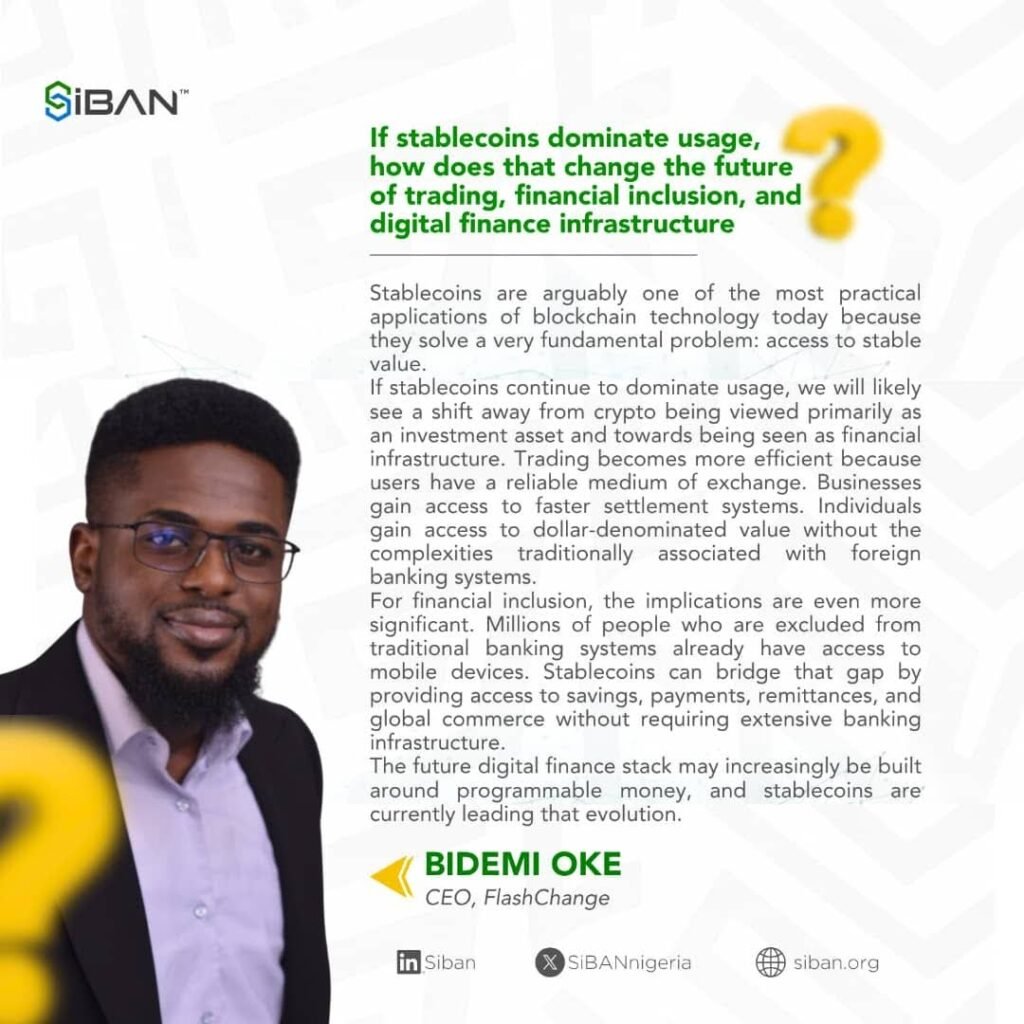
Stablecoins are arguably one of the most practical applications of blockchain technology today because they solve a very fundamental problem: access to stable value."
If stablecoin adoption continues at its current trajectory, the implications for financial infrastructure are far-reaching. Trading becomes more efficient with a reliable medium of exchange. Businesses gain access to faster settlement systems. Individuals gain dollar-denominated value without the complexity historically associated with foreign banking.
The broader vision is one of programmable money becoming the foundation of digital finance. As industry voices have noted, "millions of people who are excluded from traditional banking systems already have access to mobile devices. Stablecoins can bridge that gap by providing access to savings, payments, remittances, and global commerce without requiring extensive banking infrastructure."
The eNaira: Relevance Through Utility

Nigeria's central bank digital currency, the eNaira, represents the government's own entry into programmable money. Yet its adoption has been slower than anticipated, raising important questions about how a state-backed digital currency can remain relevant in a landscape increasingly shaped by private digital assets.
The answer, most agree, lies not in restriction or competition, but in genuine utility. A CBDC earns adoption the same way any financial product does by solving real problems better than available alternatives.
"Relevance comes from utility. The eNaira must continuously evolve around user needs rather than institutional expectations. Citizens do not adopt technology because it exists; they adopt it because it improves their lives."
This means prioritising user experience, integration with existing financial platforms, merchant adoption, interoperability, and practical use cases. The focus must shift from deployment metrics to genuine utility metrics: how many people are using it, for what, and whether it is meaningfully improving their financial lives.
Critically, the conversation about the eNaira should not be framed as a competition with private stablecoins. The two serve different purposes and can if designed with interoperability in mind complement each other within a broader digital financial ecosystem.
As he puts it: "The objective should be creating a stronger digital financial ecosystem, not forcing a winner-takes-all outcome."
Regulating the Digital Asset Space: Building a Framework That Works
Regulation is perhaps the most consequential variable in Nigeria's digital finance story. Get it wrong in either direction too restrictive or too permissive and the consequences will be felt across adoption, innovation, and investor confidence for years to come.
The question of how to classify and regulate stablecoin issuers is particularly pressing. They share characteristics with banks (holding reserves, facilitating payments) and fintechs (technology-driven, consumer-facing), but are not fully captured by either category.
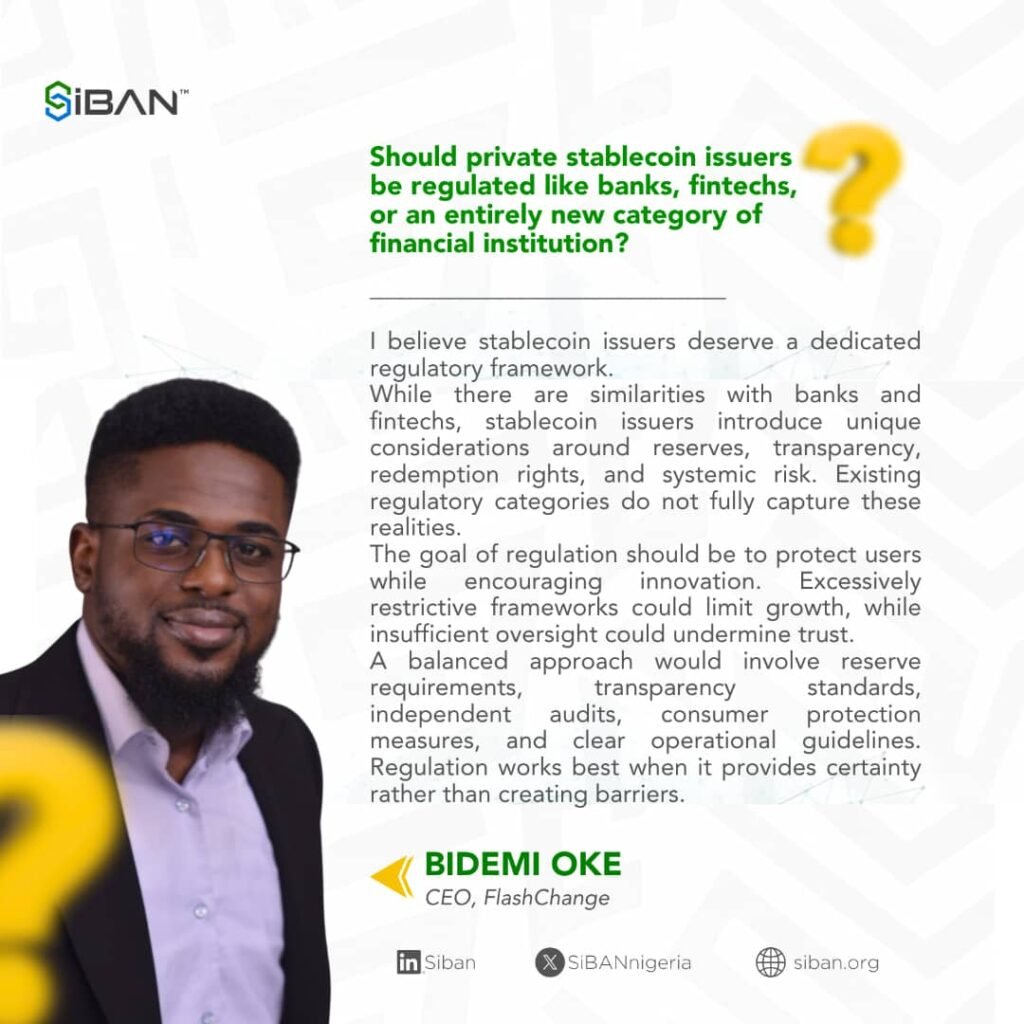
“ I believe stablecoin issuers deserve a dedicated regulatory framework. While there are similarities with banks and fintechs, stablecoin issuers introduce unique considerations around reserves, transparency, redemption rights, and systemic risk. Existing regulatory categories do not fully capture these realities."
A functional framework would incorporate reserve requirements, transparency standards, independent audits, consumer protection measures, and clear operational guidelines. The objective is not to slow innovation but to give it a stable foundation, one that protects users and builds the public trust that any financial system depends on.
The principle is clear: "Regulation works best when it provides certainty rather than creating barriers." Regulatory clarity reduces risk for operators and opens the door to greater institutional participation, deeper liquidity, and more durable long-term growth.
Financial Inclusion: Technology as Means, Not End
Nigeria's financial inclusion challenge is well-documented. Tens of millions of citizens remain outside the formal financial system, lacking access to basic savings accounts, credit, insurance, and payment services. Digital finance whether through stablecoins, CBDCs, or mobile money offers one of the most promising pathways to closing that gap.
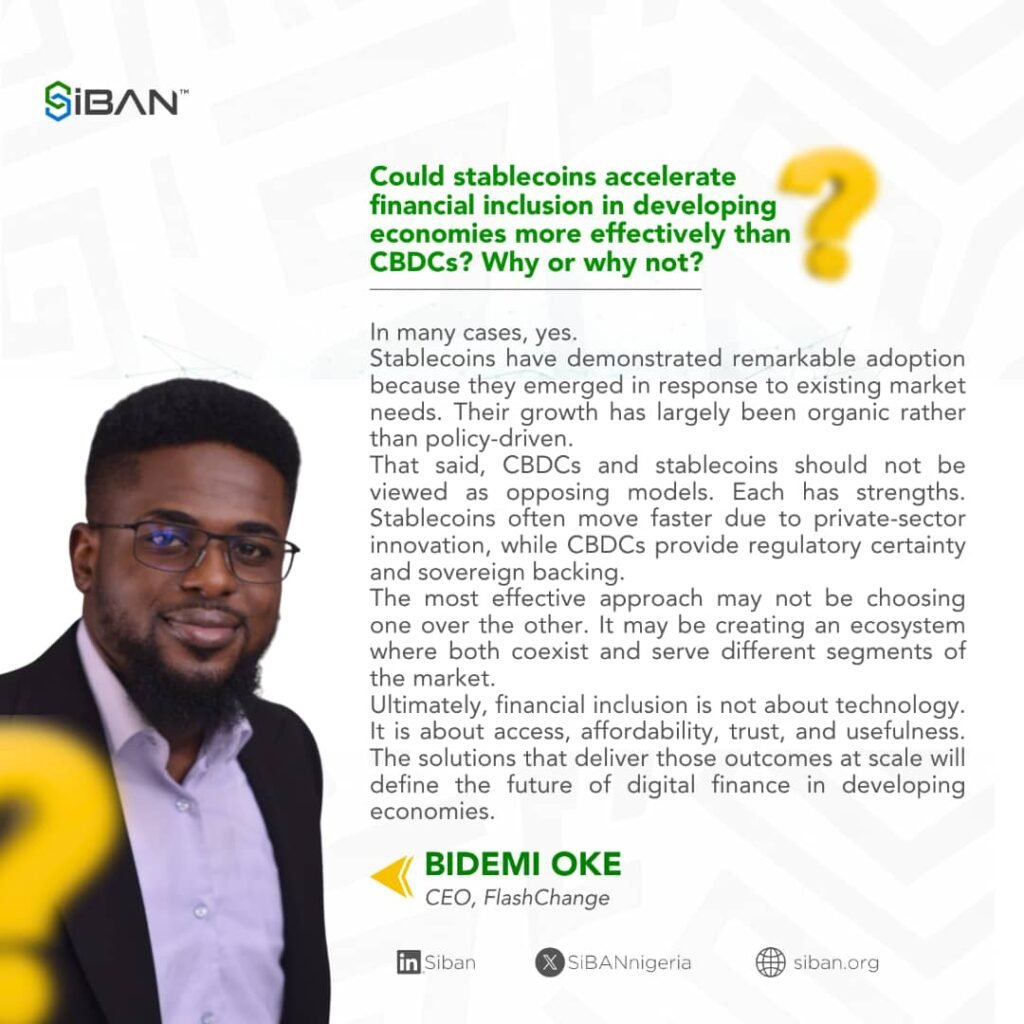
The debate about whether stablecoins or CBDCs are better suited to drive financial inclusion, however, may itself be a distraction. Both have demonstrated the capacity to reach underserved populations; what matters is that they are designed and deployed with those populations' needs at the centre.
"The most effective approach may not be choosing one over the other. It may be creating an ecosystem where both coexist and serve different segments of the market."
Stablecoins have shown the power of organic, market-driven adoption; they proliferate because users find them genuinely useful. CBDCs, backed by the state, can reach populations that private sector operators may not find commercially viable to serve. Together, they can cover more ground than either could alone.
But the most important insight may be this: technology is a means, not an end. Infrastructure, products, and platforms only create financial inclusion when they deliver access, affordability, trust, and usefulness at scale.
Nigeria's Moment to Lead
The convergence of stablecoin adoption, CBDC development, regulatory reform, and growing institutional interest in digital assets places Nigeria at a defining crossroads. The decisions made now about regulation, interoperability, financial infrastructure, and the role of the state in digital finance will shape the country's economic trajectory for a generation.
Nigeria has the community, the talent, the necessity, and the urgency to get this right. The opportunity is to build a digital financial system that is not merely modern, but genuinely inclusive one that reflects the scale of Nigeria's ambition and the depth of its people's need for financial access and security.
SiBAN remains committed to facilitating the conversations, building the networks, and advocating for the policies that will make that future possible.